
Are you spending too much on your Google Ads campaigns? Do you want to learn how to lower your cost-per-click (CPC) and maximize your return on investment (ROI)? A high CPC can quickly drain your budget, limiting your reach and impacting your overall advertising success. This comprehensive guide will provide actionable strategies to lower CPC in Google Ads, enabling you to drive more clicks and conversions without breaking the bank. We’ll delve into crucial aspects of campaign optimization, from keyword research and bidding strategies to ad quality and targeting.
Lowering your CPC is essential for achieving a successful Google Ads campaign. By optimizing your bids, improving your Quality Score, and refining your targeting, you can significantly reduce your advertising costs and improve your overall campaign performance. This article will explore proven techniques to lower CPC in Google Ads and help you achieve a higher return on ad spend. Learn how to effectively manage your bids, target the right audience, and create compelling ads that resonate with potential customers, ultimately driving more conversions at a lower cost.
Understanding What Affects CPC
Cost-per-click (CPC) is a crucial metric in Google Ads. A lower CPC means more efficient ad spend. However, CPC isn’t arbitrary. It’s influenced by a variety of factors, understanding which is key to optimizing your campaigns.
Quality Score plays a significant role. This metric assesses the relevance of your keywords, ads, and landing page. A higher Quality Score often leads to a lower CPC and better ad positioning.
Competition is another major factor. Highly competitive keywords generally have higher CPCs due to increased demand. Analyzing your competitors and identifying less competitive niches can help reduce costs.
Your bidding strategy also impacts CPC. While bidding higher can improve ad visibility, it also directly increases your costs. Automated bidding strategies can help optimize bids for conversions or clicks, potentially lowering your average CPC.
The relevance of your ad copy and targeting is crucial. Ads that resonate with the target audience and effectively address their search intent tend to achieve higher click-through rates, positively influencing Quality Score and potentially lowering CPC.
Improving Quality Score
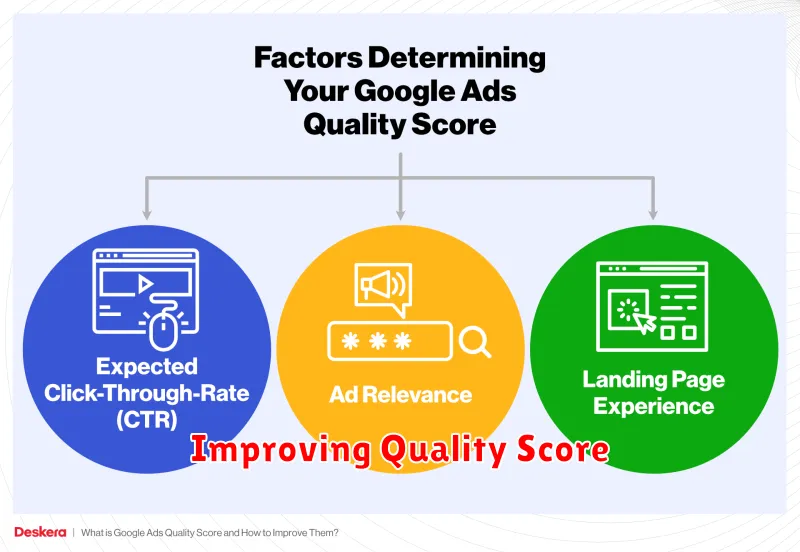
A critical factor in lowering your CPC is improving your Quality Score. Google Ads uses Quality Score to determine how relevant and useful your ads are to users. A higher Quality Score typically leads to lower CPCs and better ad positioning.
Three core components contribute to your Quality Score:
- Expected CTR (Click-Through Rate): This measures how likely your ad is to be clicked. A compelling ad copy with a clear call to action can improve your expected CTR.
- Ad Relevance: This assesses how closely your ad copy matches the user’s search query. Using relevant keywords in your ad copy is essential.
- Landing Page Experience: This evaluates the quality and relevance of your landing page. Ensure your landing page provides a positive user experience, loads quickly, and is relevant to the ad and search query.
By focusing on these three areas, you can effectively raise your Quality Score, resulting in a lower cost per click and improved campaign performance.
Keyword Match Type Strategy
A sophisticated keyword match type strategy is crucial for lowering your CPC. By refining how your keywords match search queries, you can significantly improve your Quality Score and reduce wasted spend.
Broad match offers the widest reach but often leads to irrelevant clicks and a higher CPC. Phrase match provides more control, showing your ads for searches that include your exact phrase. Exact match offers the most precision, triggering your ads only for identical searches. Finally, modified broad match offers a balance between reach and relevance, allowing you to lock in certain words with a ‘+’ sign.
Start with a tighter match type like phrase or exact match for your most important keywords. This helps build up relevant data and improve your Quality Score. As your campaign progresses, you can cautiously experiment with broader match types for keywords where relevance is less critical.
Regularly review your search term reports to identify irrelevant searches triggering your ads. Add these terms as negative keywords to further refine your targeting and lower your CPC.
Ad Relevance and Extensions
A critical factor in lowering your CPC is improving your ad relevance. Google rewards ads that are highly relevant to the user’s search query with higher Quality Scores. A higher Quality Score typically leads to a lower CPC and better ad positioning.
Ensure your ad copy directly addresses the user’s search intent. Use keywords within your ad copy that closely match the keywords you’re bidding on. This creates a strong connection between the search query, your ad, and your landing page, signaling relevance to Google.
Ad extensions are another powerful tool for increasing relevance and improving your click-through rate (CTR). Extensions provide additional information, such as sitelinks, callouts, and location extensions, making your ad more engaging and informative. A higher CTR can positively impact your Quality Score and, consequently, your CPC.
Negative Keyword Optimization
Negative keywords are a crucial aspect of lowering your CPC. They prevent your ads from showing for irrelevant searches, saving your budget from being wasted on clicks that are unlikely to convert.
By adding negative keywords, you refine your targeting and improve your Quality Score. A higher Quality Score contributes to a lower CPC and better ad positioning.
For example, if you sell “leather shoes” and notice your ads showing for searches like “free leather shoe patterns” or “how to repair leather shoes,” you should add “patterns” and “repair” as negative keywords. This ensures your ads are only shown to users actively searching to buy leather shoes.
Regularly review your search term reports to identify new negative keywords. This ongoing optimization process will continually improve your campaign performance and help lower your CPC over time.
Landing Page Experience
A positive landing page experience is crucial for lowering your CPC. Google rewards ads that lead to relevant and user-friendly landing pages with lower costs. When users find what they’re looking for quickly and easily, Google sees this as a sign of a high-quality ad and rewards it accordingly.
Key factors influencing landing page experience include:
- Relevance: Ensure your landing page content directly matches the user’s search query and ad copy.
- Ease of navigation: A clear and intuitive layout makes it easy for users to find information and complete desired actions.
- Fast loading speed: A slow-loading page can lead to a poor user experience and increase bounce rates.
- Mobile-friendliness: With a significant portion of searches happening on mobile devices, a responsive design is essential.
- Transparency and trustworthiness: Clearly display contact information, privacy policies, and security badges to build trust with users.
By optimizing your landing page experience, you can improve your Quality Score, which directly impacts your CPC.
